Divinities & Religions · Religions
The Faith
- Divinity
- None. The Faith venerates human supremacy rather than a being
- Adherents
- The state religion of Rowlem
- Reach
- Strong in the Northern Climb and the Southern Post, weak in the countryside
- Doctrine
- Humans are the only true species; all others are false constructs
- In Practice
- Non-humans are enslaved rather than cleansed, and human labourers fare little better
- Founded
- c. 650AF, by the coup that killed Kalweldin
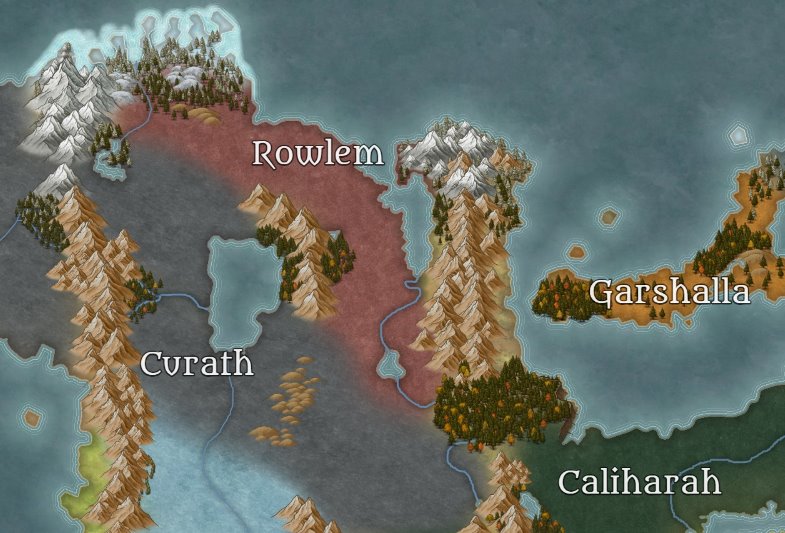
The Faith is the state religion of Rowlem, and in practice its government. Its doctrine holds that humans are the only true species and that all others are false constructs to be cleansed from the world.
That doctrine is not followed to its own conclusion. Captured non-humans are put to slave labour rather than killed, which the Faith presents as proof of their inferiority. Human labourers are not much better placed: all crops, minerals and manufactured goods are held to be the property of the Faith, collected by its enforcers and redistributed by its planners.
Kin hold a particular place in the doctrine. A false construct, in the Faith's telling, is a thing shaped to look like a person, and a kin is the only species that can be said to have visibly become one: a fox went into a field and a person came out of it. Laudites teach this as the plainest proof the Faith has, and it is the point of doctrine an ordinary Rowlem labourer can most reliably repeat. It does not survive a conversation with a kin, which is among the reasons kin in Rowlem are put to work rather than argued with.
Structure
Four ranks, in descending order of comfort:
- High Laudites, who preach the doctrine and live on what is collected
- Soldier Zealots, who enforce it
- Human labourers — farmers, homeowners and business owners
- Slaves, non-human and human
Reach
The Faith holds Rowlem's two cities of consequence — the Northern Climb and the Southern Post — and the land around each. Further out the laudites and their soldiers lack the numbers to compel anyone. They still collect, but the countryside has warning enough to hide part of what it grows.
Rowlem was not always this. For several hundred years it was ruled by the synthoid Kalweldin, and it prospered. Kalweldin is also the reason anyone knows what year it is — see Dating and Records — which is not a thing the Faith allows said within its borders.
In their own words
Bevel Dart, The Musings of a Wanderer
Of all the places I have no wish to return a-quest’n, Rowlem just about tops them all. The poor nation is run by a load of loonie zealots obsessed with the notion of human supremacy, who blame other species for all their troubles. furious illegible scribblings
Ideology
Referred to in Rowlem solely as “The Faith,” the dogma states that humans are the only real species. All other species are false constructs and must be cleansed from the world. Here the first hypocrisy of The Faith rears its ugly head: despite all the talk of cleansing the world of other species, those of other species that are captured are not exterminated as the word “cleanse” ought to infer - they are relegated to slave labor, which is supposedly a symbol of their inferiority.
Slave labor appears to be what The Faith is really about. Any of a non-human species are, as mentioned above, sent to slave labor. But the kicker is that the common (human) worker is no better off. How so, you might ask. I’ll tell you. All resources grown, harvested, mined, manufactured, or made are considered the property of The Faith. Your crops are taken from you by a band of religious thugs. Then the “planners” send you what you “ought” to have. As you can see, the destitution of the nation is thereby confirmed.
Structure & Influence
The Faith, and thus the nation of Rowlem, is structured as follows:
High Laudites, who spout the fanaticism and enjoy the liberty and luxuries they steal from the people - molicking about with other people’s money
Soldier Zealots; brutes, really, who gobble up the justification to do others harm
Human Sweat-shiners, including farmers, homeowners, and business owners, who are not much more worse off than slaves
Slaves, non-human and human
Fortunately (though unfortunate for the common people caught in the tide) the stupidity of this ideology is visible in the sorry shape of the country. The Faith only truly holds sway within and nearby the two major cities of Rowlem - one in the north and one in the south. Elsewhere the laudites and soldier zealots simply don’t have the wealth and strength to subjugate the more distant areas. Oh, they still come around to steal away people’s crops and trade goods, but the good people in the countryside have an opportunity to hide and stash some of their hard-earned resources beforehand.
History
The history of Rowlem is a tragedy. For several hundred years the country was ruled by a wise synthoid. Over its long career, Rowlem prospered. A small faction eventually became greedy for power and instigated revolution through subversion and propaganda. The faction gained enough popularity from its lies that it staged a successful, bloody coup, resulting in the tragic execution of the wise synthoid. The leaders of this faction instituted themselves as the first high laudites and made up divinity named Row to be the symbol The Faith. (as a side note, the laudites in the southern city of Rowlem have jumped on this god idea more than those in the northern city - they even have a person holding the title) The purge of non-humans after the revolution was horrifying.
The zealots now claim that all the problems of the common people are caused by non-humans. Those who contest the “fact” are branded “synthoid sympathizers.” The zealots point to the lies fabricated during the revolution, claiming life under the non-human was unfair, and at least now the power was held by their “fellow” common man - now humans are free from the yoke of impurity.
Rituals
The Faith tries to make up for their failings through heavy use of ritual and symbolism. Chained non-humans are paraded through the streets, where onlookers are expected to spit on (“cleanse”) them. When the zealots come for the farmer’s crops or the tradesperson’s goods, a nonsensical ritual is performed and the threshold of the barn or shop is marked with red symbols.
It’s no wonder Rowlem’s neighbors have no desire to invade them. The nation is economically and militaristically crippled. The puny annoyances of Rowlem’s military “cleansing” forays into Curath and Caliharah are met with stiff resistance and are far preferable to the raiders from the northern sea that Rowlem buffers them from.
Travel not to Rowlem, my friends. Only lies, misery, brutality, and slavery will welcome you.